Healthcare is the most-discussed corner of the middle market and the least precisely discussed. 'Multiples are strong' is true at the headline and useless at the table, because the word 'healthcare' covers a range wide enough to swallow most of the disagreement in any given negotiation.
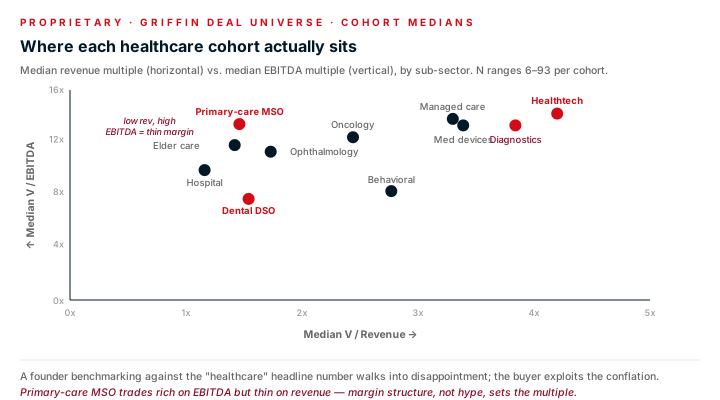
Healthcare is 62% of our universe — 953 of 1,544 deals — which is enough to cut by sub-sector and still stand on real sample sizes. Cut that way, the single 'healthcare multiple' dissolves into a 6.5-turn spread.
At the top, healthtech platforms clear a median 14.2x EBITDA, managed care 13.8x, and diagnostics and medical devices 13.3x apiece. In the middle, oncology runs 12.4x, elder care 11.8x, and ophthalmology MSOs 11.3x. At the bottom, hospital platforms sit at 9.9x and dental DSOs at 7.7x. The distance from healthtech to dental is nearly double, inside the same sector heading.
A dental founder who benchmarks against 'healthcare at 13x' has mis-set their own expectation by five or six turns before the first conversation. A buyer, who knows the sub-sector medians cold, has every incentive to let the conflation stand. The job of the comp set is to collapse 'healthcare' into the right sub-sector and price against that, with the sample size stated plainly — diagnostics on 43 disclosed deals carries more weight than ophthalmology on six.
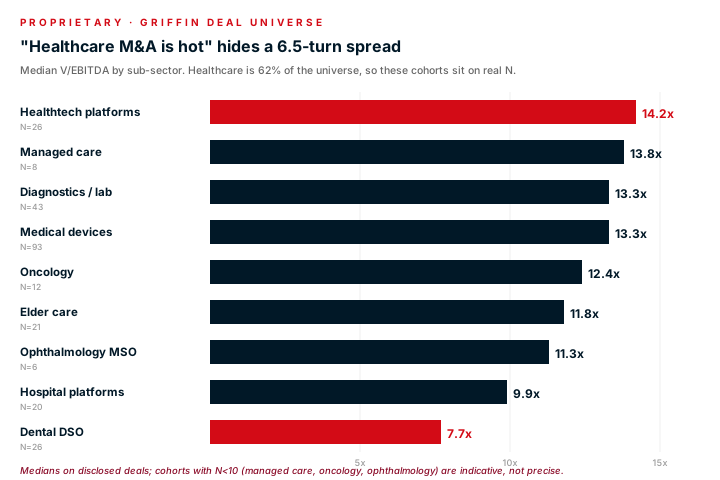
Plot each cohort on both axes — revenue multiple against EBITDA multiple — and a second layer appears. The premium cohorts cluster top-right: healthtech and diagnostics command both a high revenue multiple and a high EBITDA multiple, the signature of genuinely scarce, scalable assets. Dental and hospital platforms sit lower-left on both.
The instructive outlier is the primary-care MSO: a low revenue multiple paired with a high EBITDA multiple. That combination is not a contradiction — it is a margin signature. It says the model runs thin on revenue and is priced on the earnings it converts, which tells a seller exactly which lever — margin, not top-line — moves their valuation. Reading the two multiples together, rather than either alone, is what separates a comp set from a number.