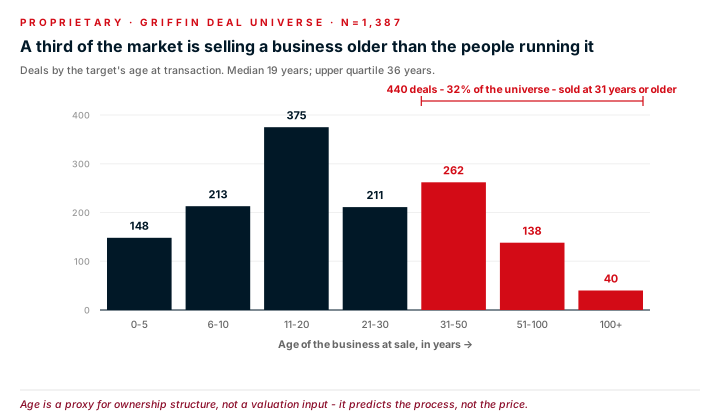
Why it matters: the readiness work a sale requires is set by how long the business has existed, and almost every seller underestimates it. A company founded in 1982 and a company founded in 2015 can carry the same EBITDA into the same process and face completely different diligence — one confirms three years of records, the other reconstructs four decades of them.
Founding year is recorded for 1,387 of the 1,544 transactions in our universe. The median company sells at 19 years old. The upper quartile is 36. A third of the market sold a business that was older than most of the people running it.
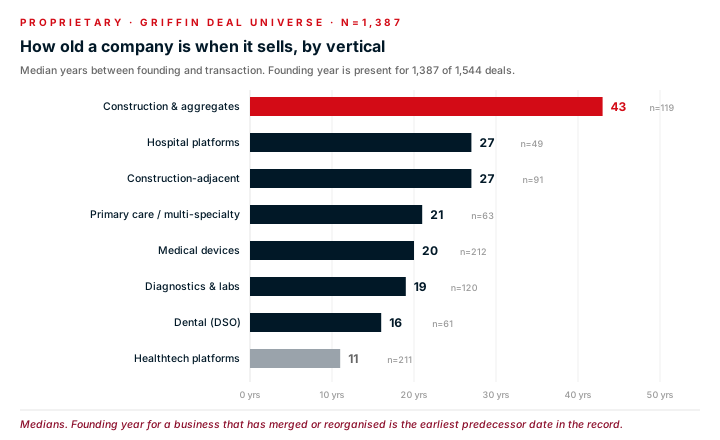
Construction and aggregates businesses sell at a median 43 years old, and half of them were founded before 1980. Two in five are past their fiftieth year. At the other end, healthtech platforms sell at a median 11 years old, and 2% predate 1980. Between them sit hospital platforms and construction-adjacent trades at 27, primary care at 21, medical devices at 20, diagnostics at 19, and dental practices at 16.
At sector level the same gap holds: industrials sell at a median 32 years old against healthcare's 17, and 55% of industrial sellers are past thirty years against 24% of healthcare sellers. The businesses that take longest to build are the ones being sold by the people who built them.
It brings foundations that were never built for a buyer to read. Financial statements compiled or reviewed rather than audited, and prepared for a tax outcome rather than a valuation one. Real property and equipment carried at a historic cost that bears no relationship to what it would fetch or replace. Related-party leases, family payroll, and personal expenses folded into the operating result across decades, each defensible on its own and none of them documented as an add-back.
It also brings the asset that diligence is worst at valuing: relationships and know-how held in one or two people's heads. A forty-year customer relationship maintained by an owner who is leaving is simultaneously the reason the business is worth buying and the reason a buyer will structure around it. That structural answer is an earnout, a rollover, or a long transition — which is to say, a slice of the price that the seller has to earn twice.
None of this reduces what the business is worth. It changes what the seller has to prove, how long proving it takes, and how much of the consideration arrives at closing.
Age is not a pricing variable and we do not present it as one. Our own cut of disclosed multiples by age band is non-monotonic — 10.7x under ten years, 10.9x at ten to twenty, 13.5x at twenty-one to thirty, 13.0x at thirty-one to fifty, and back to 10.7x past fifty. That pattern is a size and sector story wearing an age costume: the middle bands hold larger deals. Age predicts the process, not the price.
Two data limits. Founding year for a business that has merged or reorganised is the earliest predecessor date in the record, which stretches some ages beyond the life of the operating entity a buyer would actually acquire. And age correlates tightly with vertical, so the vertical medians here are describing industry structure at least as much as they are describing individual companies.
For the median 19-year-old business, readiness is a work-stream that runs alongside the process. For the 43-year-old business, readiness is longer than the process — and it is almost entirely reconstruction: normalising a decade of owner economics, appraising hard assets rather than carrying them at book, and moving the relationships that live in one person's phone into something a buyer can underwrite.
Griffin's guidance is to start that reconstruction before the buyer list, not after. A quality-of-earnings exercise run early is a document the seller controls and can correct. Run late, the same questions arrive from the buyer's accountants with a signed letter of intent already setting the clock, and every answer that takes a week costs leverage. Where the value sits in separable hard assets — a quarry, a plant, a property book — the component-parts work belongs in that same early window.