
Why it matters: a seller who spends two years improving the business and then measures the outcome in turns of EBITDA will conclude the work was wasted. It was not. The multiple fell because the denominator rose, and the price rose with it.
Sort our disclosed transactions by the EBITDA margin of the business that sold, and the two headline multiples move in opposite directions. Businesses earning a 5% margin or less cleared a median 22.5x EBITDA and 0.63x revenue. Businesses earning above 30% cleared 10.4x and 4.16x. Across the six cohorts, the EBITDA multiple falls by more than half while the revenue multiple rises more than six-fold.
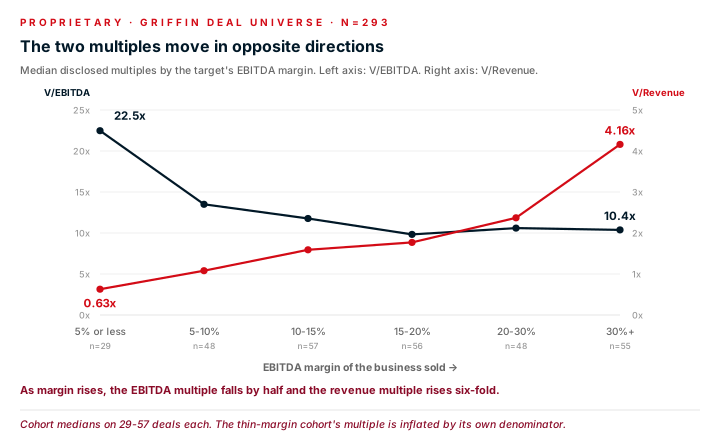
The two multiples are not independent measurements. They are linked by an identity: the revenue multiple equals the margin times the EBITDA multiple. Apply that identity to the cohort medians and it very nearly reproduces the observed revenue multiples — 0.71x, 1.09x, 1.47x, 1.69x, 2.42x, and 4.28x against actuals of 0.63x, 1.08x, 1.59x, 1.77x, 2.37x, and 4.16x.
That is the whole mechanism. A thin-margin business has a small EBITDA denominator, so any defensible enterprise value divides into a large number of turns. Nothing in the 22.5x figure says buyers prize low margins. It says buyers were valuing something other than this year's EBITDA — usually revenue, growth, or an asset base — and the EBITDA multiple is reporting that fact backwards.
The direction is consistent enough to measure. Rank correlation between margin and the EBITDA multiple is −0.23; between margin and the revenue multiple it is +0.50. One of those numbers is telling you about value. The other is telling you about a denominator.
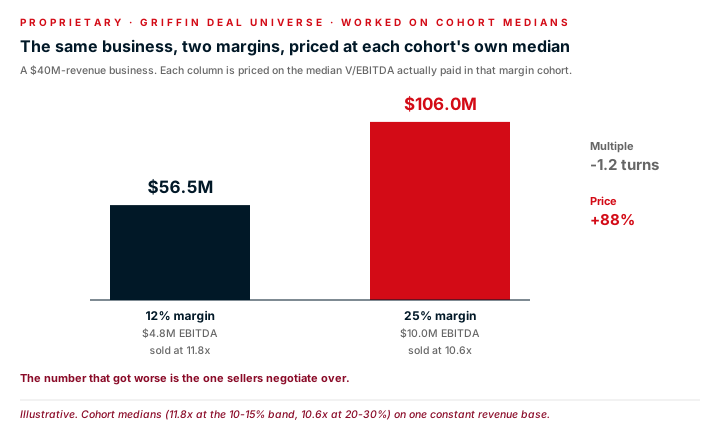
Take a business with $40M of revenue. At a 12% margin it earns $4.8M of EBITDA, and the cohort that contains it transacted at a median 11.8x — an enterprise value of $56.5M. Improve the margin to 25% and it earns $10.0M, but it has moved into a cohort that transacted at a median 10.6x. The value is $106.0M.
The multiple went down 1.2 turns. The price went up 88%. A seller who negotiated hard on the multiple and ignored the base would have been fighting over the smaller of the two numbers.
The thin-margin cohort is not a random sample. It is disproportionately growth-stage healthtech, where buyers underwrite revenue and the EBITDA line is close to zero by design. Cohort counts run 29 to 57, so these are medians on small panels, and the disclosed universe leans toward the kind of deal that publishes a multiple — a bias we have quantified separately.
The pattern survives the obvious control. Inside healthcare alone, the EBITDA multiple falls from 21.6x in the thinnest-margin cohort to 10.5x above 30%, while the revenue multiple climbs from 0.65x to 4.45x. Same sector, same shape, 22 to 46 deals per cohort.
Stop treating the multiple as a grade. It is an output of a division, and the seller controls the numerator's driver — the earnings base — far more than the divisor. Two years of margin work moves the base permanently; two rounds of negotiation move the turn count by a fraction and only once.
In practice this means three things. Establish the adjusted earnings base before anyone quotes a multiple against it, because a turn argued on an unnormalised base is an argument about the wrong number. Ask any buyer quoting a comparable multiple what margin the comparable earned. And hold the price and the standalone value as the figures that matter — the multiple is the result of the arithmetic, not an input to it.