
Every comp set rests on an assumption no one states out loud: that the deals you can see are representative of the deals you cannot. In private M&A, that assumption is false, and it is false in a direction that costs sellers money.
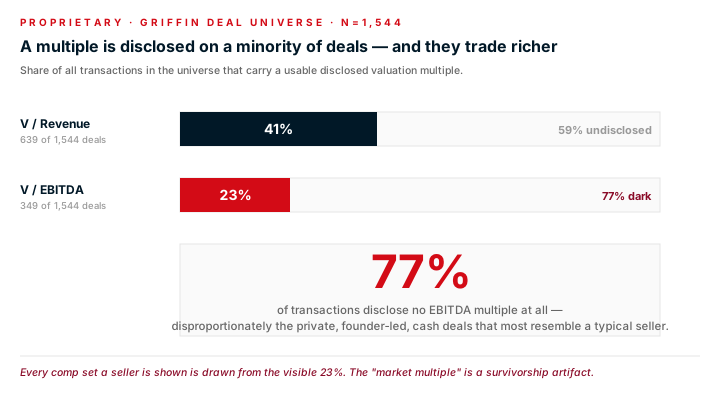
Our universe holds 1,544 transactions. A revenue multiple is disclosed on 639 of them — 41%. An EBITDA multiple is disclosed on 349 — 23%. The other 77% close without a public EBITDA multiple at all, and they are disproportionately the private, founder-led, cash transactions that most resemble a typical client.
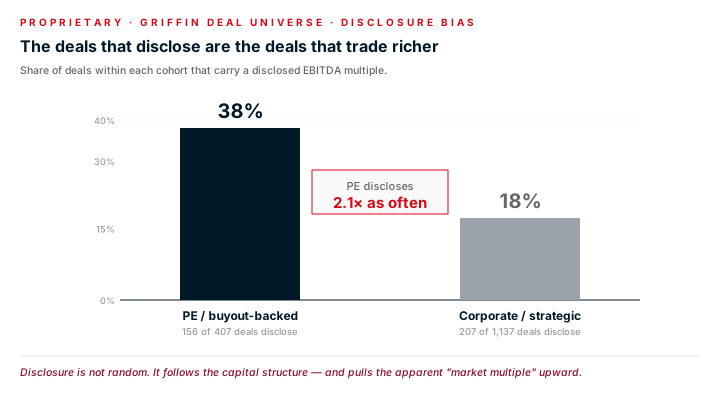
If the missing 77% traded like the visible 23%, the gap would be a nuisance, not a bias. They do not. Split the universe by capital structure and the pattern is clean: private-equity and buyout-backed deals disclose an EBITDA multiple 38% of the time, against 18% for corporate and strategic acquisitions. PE deals enter the visible record roughly 2.1 times as often as strategic ones.
That selection runs in the expensive direction. Sponsor-backed and public transactions — the ones that file, that get written up, that anchor the league tables — also tend to be the larger, more competitively run, higher-multiple deals. The quiet strategic tuck-in that closes for cash and never files is exactly the transaction that drags the true population median down, and it is exactly the transaction that never makes it into the comp set.
The disclosure gap is not a secret so much as an inconvenience. A data vendor cannot easily quantify the bias in its own coverage without indicting the coverage. The number is straightforward to compute from any tagged transaction set — it simply requires being willing to count what is missing rather than only what is present.
For a seller, the lesson is defensive and specific. When a banker shows you a comp set, the first question is not 'what is the median?' It is 'what share of deals like mine disclosed at all, and which way does the disclosure lean?' A comp set built only from the visible 23% is not the market. It is the richer-trading, more-visible slice of the market, presented as the whole.