
Why it matters: the smallest transactions in our universe clear less than half the multiple of the largest, and the single widest step on that ladder sits at the bottom, right where most privately held companies transact.
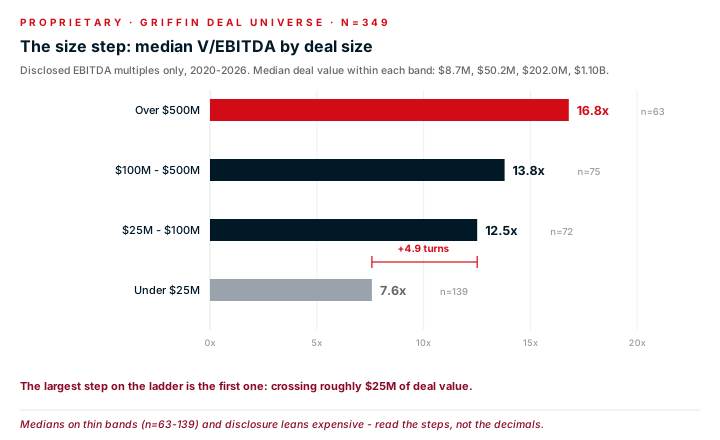
Sort 349 disclosed EBITDA multiples by deal value and the medians climb without a break. Deals under $25M clear 7.6x. Deals from $25M to $100M clear 12.5x. From $100M to $500M, 13.8x. Above $500M, 16.8x. The step from the first band to the second is 4.9 turns — larger than the two steps above it combined.
We have shown elsewhere that price climbs with the buyer channel — founder sale to add-on to platform buyout to take-private. The honest caveat on that finding was that channels bundle who pays with what trades. Size does not have the same problem.
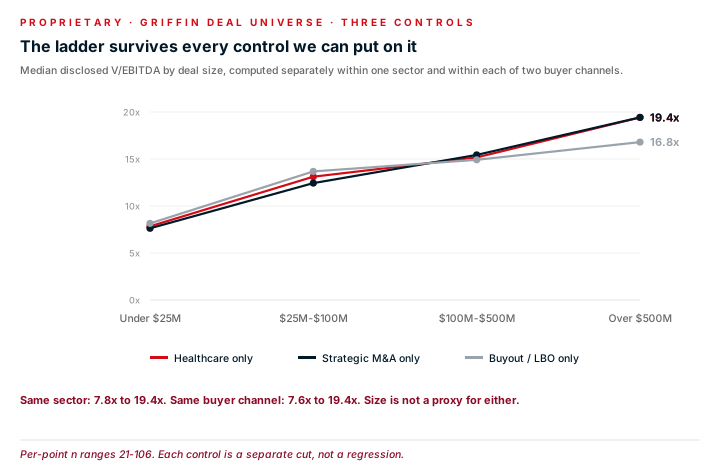
Hold the sector fixed at healthcare and the ladder is intact: 7.8x, 13.1x, 15.2x, 19.4x. Hold the buyer channel fixed at strategic M&A — one kind of buyer throughout — and it is intact: 7.6x, 12.4x, 15.4x, 19.4x. Hold it at buyouts and LBOs instead: 8.2x, 13.7x, 14.9x, 16.8x. Three separate controls, three upward ladders, and rank correlation between deal value and multiple of +0.37 across the full panel.
That is a stronger result than the channel finding. Size is not standing in for sector, and it is not standing in for who bought.
What these cuts cannot separate is size from everything that arrives with size. A $60M business has audited statements, a management team that survives the founder's departure, customer concentration in the teens rather than the forties, and a process run by people who have run one before. Some of the step is being bigger. Some of it is being the kind of company that got bigger. Nothing in this panel tells us the split, and a seller should not assume it is mostly the first.
The counts are also thin — 63 to 139 disclosed multiples per band — and disclosure leans expensive, so the sub-$25M band is the one most likely to be flattered by what does not get published. Read the steps, not the decimals. The controls above are separate cuts, not a joint model: each rules out one confound at a time.
The step is real, but it is not a reason to wait indefinitely for scale that may never arrive. It is a reason to be deliberate about three questions before going to market.
First, whether the business is close enough to the step for a defined period of growth to be worth the delay — which is a comparison of the turns gained against the value of a year, not a general preference for being larger. Second, whether a family group holding several entities is transacting as several sub-$25M businesses when it could present as one. Perimeter is a choice, and it is the one decision on this list that can move a seller across the step without operating change. Third, and most durably, whether the business can carry the attributes of the band above it into a process at its current size: audited financials, a management team that survives the sale, and a diligence file assembled before the first conversation. Those are the substitutable parts of the size premium.
What would change our view: a materially larger disclosed panel in the sub-$25M band. That is where our data is thinnest and where the disclosure bias runs hardest against the seller.