
There is a version of the last five years that everyone in the middle market tells from memory: multiples were high in 2021, the rate cycle crushed them, and they have been climbing back ever since. The memory is roughly right and precisely wrong, and the difference matters at the closing table.
We hold a proprietary database of 1,544 M&A transactions captured and tagged in-house, spanning May 2020 to mid-2026. Of those, 349 disclose a usable EBITDA multiple. Cut to the median by deal year, the data does not show a gentle compression and a gentle recovery. It shows a clean trough — and a recovery that overshot.
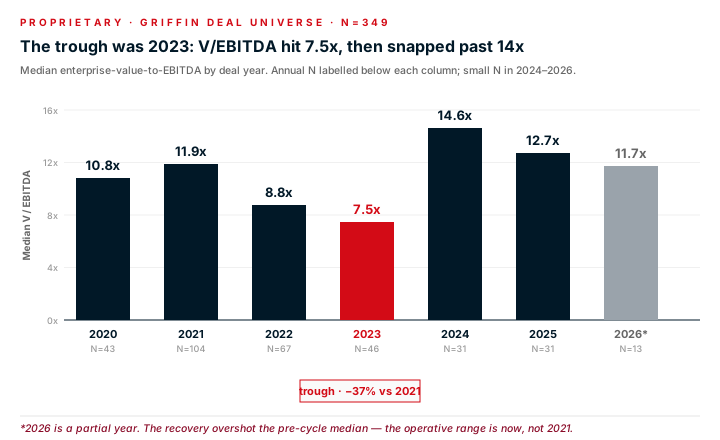
Median V/EBITDA ran 10.8x in 2020, 11.9x in 2021, 8.8x in 2022, and bottomed at 7.5x in 2023 — a 37% decline from the 2021 peak. Then it reversed hard: 14.6x in 2024, 12.7x in 2025, and 11.7x across a partial 2026. The recovery did not merely retrace the cycle. At its 2024 reading it cleared the pre-cycle 2020 and 2021 medians outright.
The honest caveat sits in the sample. Annual counts run from 31 to 104 disclosed multiples, and disclosure skews toward private-equity and public transactions. These are medians on thin, biased annual cuts, not a continuous index. Read the direction and the magnitude, not the second decimal. The direction is unambiguous: a sharp trough in 2023 and an overshoot on the way out.
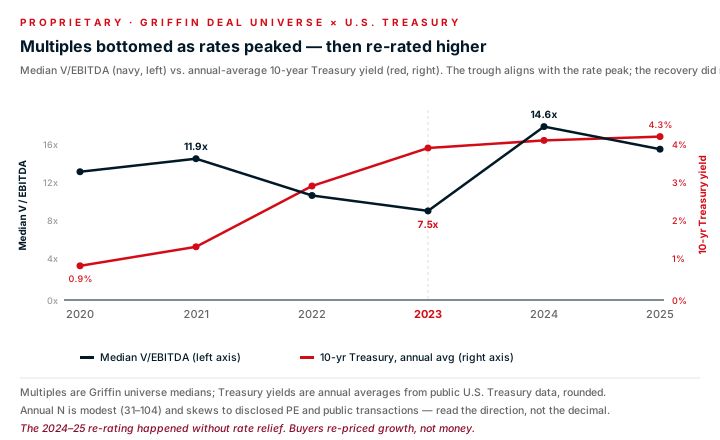
Lay the multiple series against the ten-year Treasury and the conventional story breaks. Through 2023, the textbook held: the ten-year climbed from under 1% to roughly 4%, and multiples compressed into their trough. But from 2024 onward, rates stayed elevated — and multiples re-rated anyway. Buyers did not wait for the cost of money to fall before paying up again.
That is the read-through worth carrying into a process. The 2024–25 re-rating was not a rates story; it was a growth-and-scarcity story. Buyers re-priced quality assets in a high-rate world, which is a different and more durable phenomenon than a liquidity-driven bubble. A seller who assumes the recovery is fragile because rates are still high is misreading why it happened.
The practical instruction is narrow. A comp set drawn from 2021 overstates today; a comp set drawn from 2023 understates it. The operative range is the most recent full-year reading for the relevant sub-sector, adjusted for the disclosure bias in the sample. Anchoring a negotiation to either extreme of the cycle hands the counterparty an argument.